Tuesday, August 27, 2013

representation of graphs


                                             ADJACENCY MATRIX AND GRAPHS 

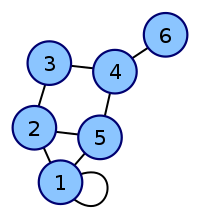
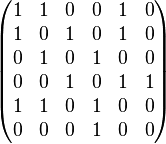
Any graphs can be represented as adjacency matrices without even drawing the vertices and edges.
6n-graph2.svg                                                                                 \begin{pmatrix}
1 & 1 & 0 & 0 & 1 & 0\\
1 & 0 & 1 & 0 & 1 & 0\\
0 & 1 & 0 & 1 & 0 & 0\\
0 & 0 & 1 & 0 & 1 & 1\\
1 & 1 & 0 & 1 & 0 & 0\\
0 & 0 & 0 & 1 & 0 & 0\\
\end{pmatrix}


Here the graph itself is represented using the adjacency matrix.Vertices connected to each other by edges are denoted as 1 and otherwise 0.This matrix is enough to identify the graph.

                                                         INCIDENCE RELATION


\begin{pmatrix}
  1 & 1 & 1 & 0 \\
  1 & 0 & 0 & 0 \\
  0 & 1 & 0 & 1 \\
  0 & 0 & 1 & 1 \\
\end{pmatrix}


                               Entry of an incidence matrix is set to 1 if an edge incidence on a vertex otherwise it is set to zero.


                                                            ADJACENCY LIST


                          In this representation,every vertexes connected to a particular edge is plotted.


classification of graphs

                               DEEPER CLASSIFICATION OF GRAPHS

Here we are classifying the graphs by considering the graphs as a set of edges and vertices.E denotes the edge set and V denotes the vertex set.

  • null graph

                                                    In a null graph none of the objects are related to each other,then the graph produced out of it is called a null graph.
  • Pseudo graph
                                                       Here we can see that two vertexes are connected to itself.So in graphs in which if any vertex is connected to itself is called pseudo graph.Such an edge is called self loop. A graph
with self loop is called pseudo graph.
  • Multi-graph
  If in any graph between two vertices there exists more than 1 relation,they are connected by more than 1 edge;such edges are called parallel edges.if in any graph there exists atleast one pair of parallel edges,such a graph is called multi-graph.


  • Simple graph


If any graph has neither a self loop nor even a pair of parallel edges is called a simple graph.
                                                 Simple graphs can be given different names depending on the structure of the graphs.
  1. complete graphs
                                   If every vertex of a simple graph is connected to all other vertices ,then that graph is known as complete graph. It  is usually denoted as k1(complete graph with i vertex),k2(complete graph with 2 vertices)..................


     2.   cycle graph 
                                If every vertex is connected to exactly two other vertices then that graph is called as a cycle graph.
It is denoted as Cn. Its first value is 3.


   3.  Path graph
                               It is a continuous sequence of vertices and edges starting from a vertex exactly at another vertex.Denoted by Pn.


   4.  star graph
                                       

   It is a graph where exactly 1 vertex is connected to each other vertex,denoted by the symbol Sn.


  5.Wheel graph

                                                 A vertex is connected to every vertex of a cycle the resultant graph is called a wheel graph denoted by Wn. Its starts from 4.


Saturday, August 24, 2013

Graphs-Introduction

                                         GRAPHS


This is graphs.Anything and everything in this environment can be connected to graphs or graph theory.Graphs are basically a set of vertices and edges.It exhibits a relationship,often functional between elements of two sets  by using coordinates.graphs are also called as plots.These definitions are not formal.These definitions  connects graphs  with real world activities or connects it with other branches of sciences.Actual definition of graphs is :Graph is a representation of set of objects where some pairs of objects are connected through links.
There are different types of graphs in Mathematics.Lets have a brief look on the basic classification of graphs.

  •  circle graph                
                 
  •  Bar graph
                                         
  •  Histogram


  • line graph


  • Picture Graph


History of graph theory

The origin of graph theory started with the problem of Koinsber bridge, in 1735. This 

problem lead to the concept of Eulerian Graph. Euler studied the problem of Koinsberg 
bridge and constructed a structure to solve the problem called Eulerian graph. In 1840, A.F 
Mobius gave the idea of complete graph and bipartite graph and Kuratowski proved that they 
are planar by means of recreational problems. The concept of tree, (a connected graph without cycles was implemented by Gustav Kirchhoff in 1845, and the employed graph 
theoretical ideas in the calculation of currents in electrical networks or circuits. In 1852, 
Thomas Gutherie found the famous four color problem. Then in 1856, Thomas. P. Kirkman 
and William R.Hamilton studied cycles on polyhydra and invented the concept called 
Hamiltonian graph by studying trips that visited certain sites exactly once. In 1913, 
H.Dudeney mentioned a puzzle problem. Eventhough the four color problem was invented it 
was solved only after a century by Kenneth Appel and Wolfgang Haken. This time is 
considered as the birth of Graph Theory. Caley studied particular analytical forms from 
differential calculus to study the trees. This had many implications in theoretical chemistry. 
This lead to the invention of enumerative graph theory. Any how the term “Graph” was 
introduced by Sylvester in 1878 where he drew an analogy between “Quantic invariants” and 
covariants of algebra and molecular diagrams. In 1941, Ramsey worked on colorations which 
lead to the identification of another branch of graph theory called extremel graph theory. In 
1969, the four color problem was solved using computers by Heinrich. The study of 
asymptotic graph connectivity gave rise to random graph theory.